
Sheer or blackout curtains for French doors? The right choice depends on what you want the room to feel like when the doors are closed. You might want to keep the garden view during the day, feel less exposed after switching on the lamps, or reduce light when it is time to sleep.
Those needs can point to different fabrics. A sheer can be lovely in daylight and still leave you wanting more coverage in the evening. A lined outer curtain can suit a bedroom, while a separate sheer lets you enjoy a softer daytime layer. Start with your routine, then choose the fabric and hardware to match it.
The short answer
Choose a sheer for the daytime look and light you enjoy, but assess evening privacy separately. Choose an appropriate blackout-lined outer curtain when stronger light control matters, while planning the gaps around the opening. If you need both daytime softness and evening coverage, compare two independently operated layers and confirm there is room for the hardware and open stacks.
Sheer or blackout curtains for French doors: start with your routine
Think about three moments: the brightest part of your day, the evening when the room lights are on, and the time you want to sleep. You may need a different kind of coverage at each one.
In a living room overlooking a private garden, the daytime view may matter most. In a bedroom facing a lit patio, controlling light after dark may be the first concern. A dining room beside a path might need evening coverage even if it never needs to be dark enough for sleep.
| Option | Daytime experience | Evening / sleep considerations | What to confirm |
|---|---|---|---|
| Sheer alone | Softens the view while letting light through; the effect depends on the weave. | Do not assume privacy with indoor lights on or meaningful darkness for sleep. | Actual weave, selected color and visibility from the relevant outside angle. |
| Denser unlined outer curtain | Can provide more visual coverage, but fabrics vary. | An unlined label does not establish a particular light-blocking level. | Opacity of the chosen fabric; no substitution of color or thickness for a verified specification. |
| Outer curtain with blackout lining | Can be drawn back during the day and closed when stronger light control is needed. | Addresses light through the lined panel; light may remain at the top, sides, center and hem. | Available lining for that product, full panel construction and coverage at the edges. |
| Separate sheer and outer layers | Lets you use the sheer while the outer panels stay open. | Close the appropriate outer layer when evening coverage or darkness is needed. | Two compatible hardware lines, stack space, weight, handle access and each layer’s order dimensions. |
These are layout choices. The fabric options below are for an above-door treatment; they are not a confirmed door-mounted kit.
If you want one fabric only, choose for the need you cannot comfortably compromise on. If you need both an open daytime feel and more evening coverage, investigate two separate layers rather than asking a sheer to do every job.
When sheer curtains are the better starting point
Sheers suit the moment when bare glass feels too exposed but closing a solid curtain would take away the part of the room you enjoy. They can soften the garden view and make a doorway feel more finished while light still comes through.
Choose the weave, not just the word “sheer”
A smooth voile, a crinkled weave and a more open textured fabric can look quite different over a full door. Compare how clearly you can see through the selected fabric and how the texture looks beside the frame. The same cream color does not make two weaves interchangeable.
A sample is a useful first filter. Hold it against the paint and door frame, then look at it in the light you normally use. It helps you rule out a color that feels too yellow or a texture that competes with the room. It is not a miniature version of the final folds, seams or stack.
Keep the view in mind when choosing fullness
More gathered fabric changes how much material sits in front of the glass. Follow the selected header and product instructions instead of assuming that one fullness ratio gives every sheer the same look. A configured wave or pleated curtain may already include its intended fullness.

A good fit for a daytime dining room
If you enjoy the garden view over breakfast but dislike the bare-glass feel, start by comparing simple white and textured sheers. Decide the evening layer separately before ordering the hardware.
Do sheer curtains give privacy at night?
Do not make that decision from a bright daytime room photograph. Visibility changes with the weave, the lighting on each side of the glass, distance and viewing angle. The situation after dark, with the room lights on, can be very different.
Also decide what you mean by privacy. Hiding small details is not the same as making a person’s silhouette invisible. A curtain that feels comfortable beside a secluded garden may not be enough beside a close neighboring window or a frequently used path.
Look from the position that matters
Where it is appropriate to do so, assess the view from the actual outside direction with the room lit as usual. Do not use a well-lit interior view looking out as proof that people outside cannot look in. If that outside check is not possible, ask for specific information about the selected fabric rather than relying on a general privacy label.
If dependable evening coverage is important, compare a suitable opaque outer fabric or lining and plan its full coverage. You do not have to give up the daytime sheer to make that choice.
Keep samples and full-size performance separate.
A swatch can show weave and color. It cannot reproduce the installed folds, seams, surrounding gaps or the full view through your doors. Use it to shortlist fabrics, then confirm the construction and intended coverage.
When a blackout-lined outer curtain makes sense
A bedroom, a room used for daytime sleep, or a screen-facing room with troublesome light may need more control than a sheer provides. Start with a curtain whose selected fabric and lining are intended for that job, then plan how the opening will be covered.
Separate the face fabric from the lining
The face fabric gives you the color, weave and visible folds. A lining is an additional part of the construction. Where a product offers lining choices, check the actual option you are selecting; a photograph of a substantial-looking face fabric does not establish the lining behind it.
“Unlined” describes the absence of an added lining, not one universal opacity level. Likewise, a darker color or heavier texture is not a reliable shortcut to a blackout specification. Compare the selected construction rather than choosing by color alone.
Blackout fabric does not close installation gaps
A lined panel addresses light passing through its covered area. Light can still enter around the top and sides, between meeting panels or below the hem. If the doorway includes uncovered sidelights or glass above the frame, those areas remain separate decisions.
You can prefer a pale curtain and still investigate blackout lining. Ask which lining is available for that fabric, whether it changes the reverse appearance, and how it affects the finished panel and care requirements. Our curtain lining guide introduces the choices; the product configuration determines what you can order.

A good starting point for a bedroom
If light keeps you awake, begin with the outer curtain and edge coverage. Add a sheer if you also want daytime softness; the extra layer should serve a useful routine rather than just complete a room photograph.
When two layers are worth the extra planning
Two layers are useful when the room changes through the day. You might leave an ivory sheer across the glass while reading, then close a lined outer curtain after switching on the lamps. Independent layers let you choose that coverage without replacing the whole treatment.
Allow room for both fabrics
Each layer needs a compatible rod or track line, enough separation to travel without rubbing or catching, and somewhere to gather when open. Two fabrics do not simply occupy the same space as one.
Include the lining in the outer stack. Then look at the sheer stack as well. A narrow strip of wall that seems sufficient for one light panel may become crowded when both layers gather there. Door handles, inward-opening leaves and the walking route still need to work.
Measure each layer for its own hardware
The inner and outer runs may differ. Their hanging references and intended hems may also differ. Follow the relevant product and header instructions for each rather than copying one width and length into both orders.
Before choosing the hardware, read our guide to hanging curtains on French doors without blocking the handles. It covers the door swing, side stacking and the movement checks to make before ordering.
One layer may be enough
If you rarely need the second layer, a simpler treatment can be easier to open, clean and live with. Think through a normal week: if the sheer would stay permanently stacked or the outer curtain would never close, decide whether it adds enough value for your room.
Check your room in the conditions you actually use
Before making a final fabric choice, write down what bothers you about the current doors. Is it glare on a screen, visibility from a path, a streetlight at bedtime, or simply the look of bare glass? One specific problem is easier to solve than a general wish for “more privacy.”
| When to check | What to look at | What the result helps you decide |
|---|---|---|
| At your brightest usual time of day | Glare at the sofa, table or screen; how much of the garden view you want to keep. | Whether a sheer gives the daytime experience you want or a more substantial layer is needed. |
| After dark, with your usual indoor lights on | Visibility from the relevant outside viewing position, where access is appropriate. | Whether the proposed fabric provides the evening coverage you need. |
| At the time you want to sleep | Streetlights, garden lights and gaps around the intended curtain coverage. | Whether to prioritize a blackout-lined outer layer and a more carefully planned installation. |
| While using the doors | Space for gathered panels, handle access and the walking route. | Whether the chosen single or double-layer arrangement works in daily use. |
A small swatch can help compare fabric, color and weave. It cannot prove the privacy or darkness of a full installed curtain; obtain the product’s construction details and assess the completed treatment.
Keep the note beside the fabric shortlist. If the main concern is evening visibility, a prettier daytime sheer does not answer it. If your priority is a bright garden-facing room, choosing the most light-blocking option without considering how it opens may leave you less happy during the day.
Fabrics to compare for your French doors
Explore our French door curtains to compare fabrics, lining options and hanging layouts for your room. The shortlist below separates daytime sheers from outer fabrics. It does not imply that every outer curtain has blackout lining selected or available.
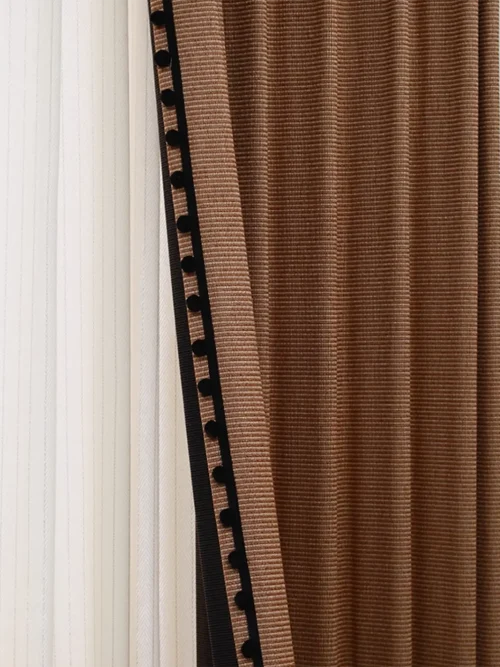
Luxury Striped Tweed Curtains – Vintage Inspired Textured Window Panels
$63.50Original price was: $63.50.$41.30Current price is: $41.30.Luxury Double-sided Jacquard Linen-Cotton Blend Curtains
$63.50Original price was: $63.50.$41.30Current price is: $41.30.Handwoven French Waffle Cotton Voiles – Crinkled Organic Sheer Curtains
$45.00Original price was: $45.00.$36.00Current price is: $36.00.Designer 3D Floral Cut-Out & Fringed Striped Linen-Cotton Voile Curtains – Artisan Textured Sheer Drapery
$56.90Original price was: $56.90.$37.00Current price is: $37.00.Cream White Sheer Curtains – Light-Filtering, No-Shadow Privacy
$35.00Original price was: $35.00.$25.00Current price is: $25.00.Oatmeal Pinch Pleat Linen Curtains for Bedroom Pinch Pleated Ceiling Mount Track Curtains
$45.50Original price was: $45.50.$36.40Current price is: $36.40.


If two fabrics are still close, compare swatches in your room before deciding. A warmer white may suit one painted frame and feel too creamy beside another. Make that decision with the room in front of you, then confirm the full configuration.
Check the lining, weight and care before checkout
Changing the lining can change more than the light control. Recheck the complete curtain’s weight against the selected hardware, the size of the gathered stack and how the finished panel should be cleaned.
Do not assume that a washable face fabric means the fully lined curtain can be washed in the same way. Follow the care instructions for the selected combination. A pair that is awkward to remove from a high track may need a different maintenance plan from an easily reached dining room curtain.
With two layers, you may clean the sheer and outer panels at different times. Check how each attaches to its carriers and whether you can remove it without dismantling the other track. Keep the product instructions with your measurements for later reference.
Make the final choice in this order
- Name the main need. Daytime softness, evening privacy, light control for sleep, or a combination.
- Choose the arrangement. One suitable layer or separate sheer and outer curtains.
- Check the selected fabric. Review weave, opacity information, color and any available lining.
- Plan coverage. Include the top, sides, center and any adjacent uncovered glass.
- Check the doorway. Confirm stacks, door swing, handle access and hem position.
- Confirm each order. Verify the width convention, panel quantity, header, drop and care requirements.
For a daytime room, begin with the sheer experience you want and decide whether you need an evening layer. For a bedroom where light is the problem, begin with the outer construction and installation coverage. If the room needs both, plan the two tracks and stacks before placing either order.
Choose the coverage that fits your day
Compare the French door collection with your room notes beside you, or start with swatches if the color and texture are still undecided.
Questions about sheer and blackout French door curtains
Are sheer curtains enough for French doors?
They may suit your daytime preferences, but do not assume they meet your evening privacy or sleep needs. Consider the actual weave, lighting and viewing position, then decide whether a separate outer layer is needed.
Do I have to choose dark curtains for blackout?
No. Compare the actual fabric-and-lining construction rather than treating color as proof of light blocking. Check which lining is available for the pale face fabric you prefer and how the complete treatment covers the opening.
Will blackout curtains make the room completely dark?
A suitable lined panel can address light through the fabric, but gaps around the installation and uncovered glass can still admit light. Complete darkness depends on the full treatment and room conditions, not the fabric label alone.
Can I put sheer and blackout curtains on the same rod?
A single shared line may not provide the independent movement you want. For separately operated layers, confirm a suitable double-rod or double-track system and compatible attachments. Check the space and complete load.
Should both layers have the same dimensions?
Not automatically. Measure each layer for its own run, header and intended hem position. Follow the specific ordering convention instead of copying one set of dimensions into both products.
Does a thicker sheer guarantee night-time privacy?
No. Thickness alone cannot establish visibility under different lighting. Review the selected weave and product information, and assess the real installation in the conditions that matter to you.
Can these curtains be attached directly to each French door?
The shortlist is for planning curtains above the opening. A treatment that moves with each door needs its own confirmed product and mounting system. Use the hanging guide before choosing an installation.


